
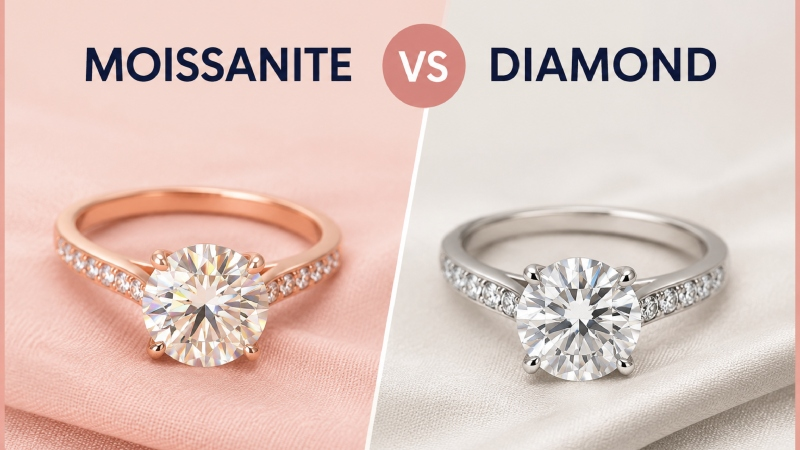
Choosing an engagement ring is one of the most significant decisions you’ll ever make. At the heart of that decision lies a modern dilemma: should you choose a diamond, the classic symbol of enduring love, or a moissanite, the brilliant and budget-friendly alternative? The debate of moissanite vs diamond has never been more relevant.
To an untrained eye, they can look remarkably similar. Both are dazzling, hard, and perfect for everyday wear. However, their differences in origin, optical properties, and value are stark. This guide will delve deeply into the moissanite vs. diamond comparison, exploring 7 key areas of contrast to help you decide which gemstone aligns with your values, style, and budget.
By the end of this guide, you’ll have a comprehensive understanding of the science, economics, and aesthetics of each stone, empowering you to make a confident, informed purchase in 2026.
What Is a Diamond?
A diamond is a mineral composed of pure carbon, formed deep within the Earth’s mantle under extreme heat and pressure over the course of billions of years. This natural process creates the hardest known substance on the planet, scoring a perfect 10 on the Mohs hardness scale.
For centuries, diamonds have been the ultimate symbol of love, commitment, and prestige. The first recorded diamond engagement ring was given in 1477, establishing a tradition that continues to define romance today. A natural diamond’s rarity, history, and durability make it a timeless heirloom.
Modern buyers can also choose lab-grown diamonds. They have the same chemical, physical, and optical properties as natural diamonds but are created in advanced laboratories rather than mined. Even professional jewelers need specialized equipment to tell them apart.
Key Characteristics of Diamonds:
- Made of pure carbon
- Formed naturally over billions of years (or lab-created)
- Hardest natural substance on Earth (10 Mohs)
- Classic, white-light sparkle
- Holds significant resale value
What Is Moissanite?
Moissanite is a gemstone composed of silicon carbide (SiC). It was first discovered in 1893 by French chemist Henri Moissan in a meteor crater in Arizona. While natural moissanite is incredibly rare, the moissanite used in jewelry today is entirely lab-created.
Because it is created in a laboratory, moissanite is often marketed as an ethical and sustainable choice. It has a hardness of 9.25 on the Mohs scale, making it the second-hardest gemstone used in jewelry and highly resistant to scratching.
Lab-created moissanite offers outstanding brilliance, excellent durability, and an affordable price. Because of these qualities, it has become one of the fastest-growing choices for engagement rings and fine jewelry.
Key Characteristics of Moissanite:
- Made of silicon carbide
- Lab-created (no mining required)
- Second-hardest gemstone at 9.25 Mohs
- Rainbow, “disco ball” sparkle
- Significantly more affordable
7 Key Differences: Moissanite vs Diamond
The best way to understand the moissanite vs. diamond debate is to compare their properties side by side. Let’s break down the seven most important distinctions.
1. Brilliance and Sparkle: The “Rainbow” vs “White Light”
The most noticeable difference between moissanite and a diamond is how they interact with light.
Diamond: Reflects light primarily as “white light” (brilliance), with a balanced mix of colorful “fire.” This creates a classic, crisp sparkle that is sophisticated and timeless. When you look at a diamond, you see deep, white flashes that feel elegant and understated.
Moissanite: Has a higher refractive index (2.65-2.69 vs diamond’s 2.42) and significantly higher dispersion. This means it bends light more intensely, resulting in a “rainbow effect” with fiery, colorful flashes. The GIA notes that in stones of one carat or more, this intense fire can give them away as non-diamond gems, sometimes described as a “disco ball” effect.
Some buyers love this extra sparkle, while others prefer the classic brilliance of a diamond. Without specialized equipment, most people cannot distinguish the two gemstones.
The Verdict: If you prefer a classic, subtle white sparkle, a diamond is the winner. If you love a bold, rainbow-colored flash, moissanite is for you.
2. Hardness and Everyday Durability
For a ring worn every day, durability is non-negotiable.
Diamond: A perfect 10 on the Mohs scale. It is the hardest natural substance on Earth and virtually scratch-resistant. This means it can withstand daily wear and tear without losing its polish or clarity.
Moissanite: A 9.25 on the Mohs scale. It is the second-hardest gemstone used in jewelry, making it extremely durable and resistant to scratching. However, diamonds are harder and have a different crystal structure, making them more resistant to chipping over very long periods.
For engagement rings, wedding bands, and everyday jewelry, both gemstones perform exceptionally well.
The Verdict: Diamonds are the ultimate in durability, but moissanite is also highly suitable for daily wear. Both will last a lifetime with proper care.
3. Value and Price
This is where the moissanite vs diamond comparison becomes most stark.
Diamond: Natural diamonds are rare and finite, which commands a premium price. A one-carat natural diamond can cost anywhere from $5,000 to over $20,000, depending on the 4Cs. Lab-grown diamonds are more affordable but still cost significantly more than moissanite.
Moissanite: Lab-created moissanite is much more affordable. A one-carat moissanite can cost roughly $500 to $800, which is a fraction of the cost of a diamond. In many cases, it costs 80% to 90% less than a natural diamond of similar size and appearance.
The Verdict: Moissanite offers unmatched value for those seeking maximum size and sparkle on a budget. Natural diamonds generally retain value better than moissanite, although resale prices often differ from retail prices.
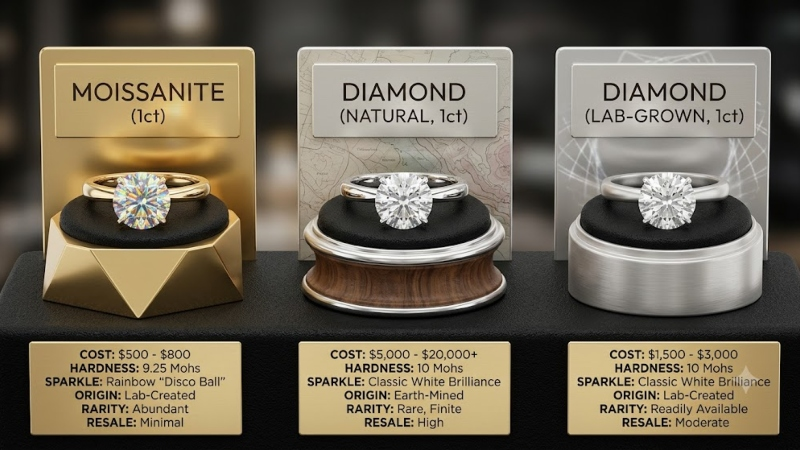
Comparison Table: Moissanite vs Diamond
| Feature | Moissanite | Diamond (Natural) | Diamond (Lab-Grown) |
| Cost (1ct) | $500 – $800 | $5,000 – $20,000+ | $1,500 – $3,000 |
| Hardness | 9.25 Mohs | 10 Mohs | 10 Mohs |
| Sparkle | Rainbow, “disco ball” | Classic white brilliance | Classic white brilliance |
| Rarity | Lab-created, abundant | Rare, finite supply | Lab-created and readily available |
| Resale Value | Minimal | High | Moderate |
| Origin | Lab-created | Earth-mined | Lab-created |
Buying Tips
Before making your final decision, compare both gemstones under natural daylight and indoor lighting, as their sparkle can look different. Buy from a trusted jeweler, check the return policy, and ask for a grading certificate if you’re purchasing a diamond. These simple steps can help you choose a gemstone you’ll be happy with for years.
4. Rarity and Sentimental Value
Diamond: Natural diamonds are ancient, formed over 1-3 billion years ago, making them one of the oldest substances on Earth. Their natural rarity and the billions of years it took to form them imbue them with profound sentimental and heirloom value. A diamond ring carries the weight of history and tradition.
Moissanite: Lab-created moissanite is produced in just 2-3 months in a factory. While it is a beautiful gemstone, it lacks the age, history, and rarity of a natural diamond. It doesn’t carry the same “forever” symbolism that diamonds do.
The Verdict: Diamonds carry an unrivaled, deep emotional significance and legacy that moissanite cannot replicate. If symbolism matters deeply to you, Diamond may be the better choice for buyers who prioritize tradition and rarity.
5. Environmental and Ethical Impact
Ethical shopping has become more important than ever.
Moissanite: Because it is lab-created, moissanite is often lauded as a conflict-free and environmentally friendly choice. There is no mining involved, which eliminates habitat destruction and the ethical concerns associated with conflict diamonds.
Diamond: Natural diamonds have a complex impact. The industry has made significant strides in sustainability and supports millions of livelihoods globally. However, mining does have environmental consequences. Lab-grown diamonds offer an ethical alternative without the mining concerns.
Both options allow buyers to choose beautiful gemstones with greater confidence.
The Verdict: Both have environmental costs associated with production. Moissanite is inherently conflict-free, while lab-grown diamonds offer a sustainable alternative to mined diamonds. If you’re concerned about ethics, either moissanite or lab-grown diamonds is a good option.
6. Color and Clarity
Diamond: Diamonds are graded on a color scale from D (colorless) to Z (light yellow or brown). They are available in a wider range of hues and are known for their exceptional clarity. The best diamonds are completely colorless and flawless.
Moissanite: High-quality moissanite is available in near-colorless and colorless options. However, under certain lighting conditions, some stones may display a slight gray, icy, or faint yellow tint, especially in larger stones. This is because lab-created moissanite often contains trace elements that affect color.
Most people never notice this difference during everyday wear, especially once the stone is set in jewelry.
The Verdict: Diamonds generally offer better color and clarity options. If you want a completely colorless stone, a high-quality diamond is your best bet.
7. Certification and Testing
Diamond: Natural and lab-grown diamonds are graded by independent gemological laboratories such as GIA, which provide a detailed and reliable assessment of quality. This gives buyers confidence in their purchase.
Moissanite: The grading standards are less uniform. Moissanite can be tricky to identify, as it will pass a standard diamond tester’s “thermal test.” Expert gemologists must use electrical conductivity tests to tell them apart.
The Verdict: Diamonds have a more established certification system. Moissanite lacks this uniformity, which can make buying it more confusing for consumers.
Pros and Cons
Diamond Pros
- Unmatched hardness and durability
- Classic, sophisticated sparkle
- Strong resale value
- Deep historical and sentimental significance
- Well-established certification system
Diamond Cons
- Very expensive
- Mining has environmental and ethical concerns
- Requires significant investment
Moissanite Pros
- Significantly more affordable
- Lab-created, conflict-free
- Brilliant rainbow sparkle
- Durable enough for daily wear
- You can get a much larger stone for your budget
Moissanite Cons
- Lower hardness than diamond (though still durable)
- May show color tint in larger stones
- Lacks the historical significance of diamonds
- Minimal resale value
- Can be mistaken for a “fake” diamond
Making the Right Choice: Moissanite vs Diamond
So, which should you choose? The “right” answer depends entirely on your priorities.
A Diamond Is Best If…
- Tradition and symbolism are important to you.
- You want a gemstone with the highest possible durability.
- You view the ring as a financial investment and an heirloom.
- You prefer the classic, white-light sparkle.
- You want a gemstone with a well-established certification system.
- You care about long-term resale potential.
Moissanite Is a Great Option If…
- You are working with a strict budget.
- You want a significantly larger stone for the same price.
- You prefer a flashy, “disco ball,” rainbow sparkle.
- You are not concerned with the stone’s resale value.
- You want a conflict-free, lab-created gemstone.
- You value beauty and sparkle over investment value.
A Lab-Grown Diamond May Be Right If…
- You want the durability and look of a diamond.
- You want a conflict-free option.
- You want better value than a natural diamond.
- Budget is still a consideration, but you want a “real” diamond.
Real-World Scenarios: Which Stone Fits You?
Scenario 1: The Budget-Conscious Couple
You’re young professionals starting your lives together. You want a beautiful ring, but don’t want to go into debt for it. A moissanite ring allows you to get a stunning 2-carat stone for under $1,500, leaving more money for your future.
Scenario 2: The Traditionalist
You’ve always dreamed of a diamond engagement ring. The symbolism and history matter deeply to you. You want something that will hold its value and can be passed down as an heirloom. A natural diamond is the only choice that will satisfy this.
Scenario 3: The Ethical Shopper
You’re concerned about the environmental and human rights impacts of mining. You want a beautiful ring that aligns with your values. Both moissanite and lab-grown diamonds are excellent choices, with moissanite being the more affordable option.
Scenario 4: The Sparkle Lover
You want maximum sparkle and flash. You love the rainbow “disco ball” effect and want your ring to catch everyone’s eye. Moissanite delivers this in spades, often outshining diamonds in certain lighting conditions.
Expert Tips for Buying
- See them in person: Photos and videos don’t do justice to the differences in sparkle. Visit a jeweler and view both stones side by side in different lighting conditions.
- Check the return policy: Always buy from a retailer with a generous return policy. You need time to see the stone in different lighting environments.
- Consider the setting: it can affect how the stone appears. A halo setting with moissanite can be overwhelmingly sparkly, while a solitaire diamond lets its classic brilliance shine.
- Ask about certification: For diamonds, always ask for a GIA or IGI certificate. For moissanite, ask about the brand and quality grade.
- Think about maintenance: Both stones require regular cleaning to maintain their brilliance. Clean your jewelry using warm water, mild soap, and a soft toothbrush. Rinse thoroughly and dry with a soft cloth. Avoid exposing your jewelry to harsh chemicals, and store each piece separately to prevent scratches.
Frequently Asked Questions
Is moissanite a diamond?
No. Moissanite is a separate gemstone composed of silicon carbide. It is a diamond simulant, meaning it looks similar but has different physical and chemical properties.
Can a jeweler tell the difference between moissanite and diamond?
Yes. While moissanite passes a standard diamond tester (which tests thermal conductivity), professional testers can easily identify it by its electrical conductivity and the “double refraction” effect.
Does moissanite get cloudy?
No. High-quality moissanite does not get cloudy over time. It is highly durable and will remain brilliant for a lifetime with proper cleaning and care.
Is moissanite cheaper than a diamond?
Yes, significantly. Moissanite is roughly 70-90% cheaper than a lab-grown diamond and can be up to 90% cheaper than a natural diamond of comparable size.
Can moissanite pass as a diamond?
To the untrained eye, yes. However, a jeweler or gemologist can easily identify it. The rainbow sparkle is often a giveaway.
Which is more durable, moissanite or diamond?
Diamond is more durable. It scores a perfect 10 on the Mohs scale, while moissanite scores 9.25. Both are suitable for daily wear.
What is the best diamond alternative?
Moissanite is considered one of the best diamond alternatives due to its brilliance, durability, and low cost. However, for those seeking a true diamond, lab-grown diamonds are a fantastic option.
Do moissanite rings have resale value?
Moissanite has very minimal resale value. It’s best to view it as a purchase for personal enjoyment rather than an investment.
Common Buying Mistakes
Many buyers focus only on price and overlook factors like durability, ring setting, and long-term satisfaction. Instead of following trends, choose the gemstone that matches your lifestyle, budget, and personal style. A well-informed decision is always better than simply buying the most expensive option.
Final Verdict
The choice between moissanite and diamond is ultimately personal. Both are stunning gemstones with unique strengths. A diamond offers an unparalleled legacy of history, durability, and romance. Moissanite provides breathtaking sparkle and exceptional value. Think about what matters most to you and your partner. Is it the tradition and symbolism, or is it the budget and value? Is it the ethical considerations? There’s no wrong answer—only the right answer for your unique situation.
If you want a luxury gemstone with a long history and stronger resale value, a diamond is an excellent investment. If you want maximum sparkle, impressive durability, and significant savings without sacrificing beauty, moissanite is a smart modern choice. By weighing the seven key differences outlined above, you can confidently choose the gemstone that best represents your love story and will bring you joy for a lifetime. Whether you choose moissanite or diamond, investing in a quality stone from a trusted jeweler will ensure your jewelry remains beautiful for many years to come.
Have questions about trends or need help refining your style? Contact us anytime for the latest fashion tips and updates.

Erin Durkheim is an author and content contributor at Gingerbread Nails, covering nail designs, nail care, beauty tips, fashion, and product-related topics. She focuses on creating practical, easy-to-understand content that helps readers explore nail trends, care routines, and everyday beauty ideas.