
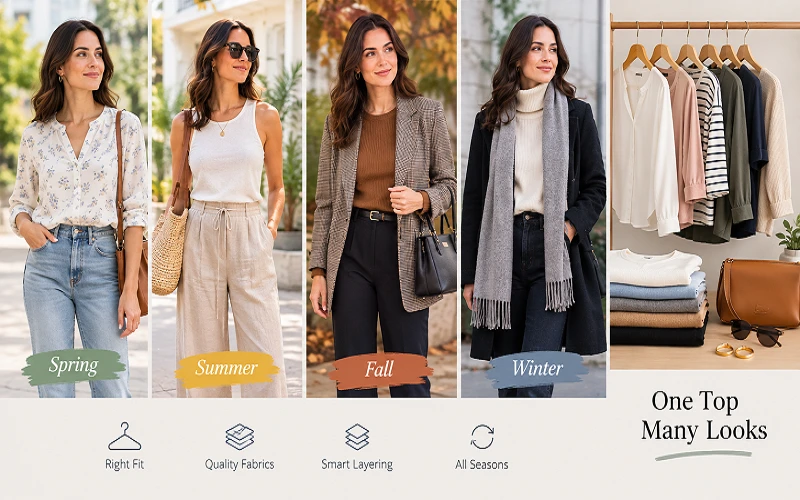
A top is often the piece that gets the most wear and the least strategic thought. It sits closest to the face, does the heaviest lifting in defining an outfit’s tone, and yet many wardrobes end up with tops chosen impulsively rather than selected with any real plan for how they will layer, transition, or hold up across a full year. Building a more deliberate collection of tops, ones that move between professional, casual, and seasonal needs, changes how much a wardrobe can actually accomplish with fewer total pieces.
Why Tops Carry More Outfit Weight Than Most People Expect
A top sits at the visual center of nearly every outfit, which means small differences in fit, fabric, and neckline change the entire impression an outfit gives, even when the bottom half stays identical. A structured button-down and a soft draped blouse can both pair with the same tailored trouser, yet they signal completely different levels of formality and ease.
This centrality is also why tops tend to wear out faster and get replaced more frequently than other wardrobe categories. Fabric near the collar and underarms takes the most stress from daily movement and washing, so a top built from a durable, well-constructed fabric earns its place in a wardrobe far longer than one chosen purely for a trend. Recognizing how much visual and practical work a top does is the first step toward choosing pieces intentionally rather than reactively.
Selecting Tops That Move Between Professional and Casual Settings
The most efficient tops are the ones that do not require a separate professional wardrobe and casual wardrobe to exist side by side. A silk or silk-blend blouse in a neutral tone, for instance, reads polished tucked into tailored trousers for a client meeting, then works equally well untucked over jeans for a weekend outing, simply by changing what surrounds it. This kind of dual-purpose thinking reduces the total number of pieces needed while increasing how often each one actually gets worn.
Neckline and structure play a large role in this versatility. A shirt with a defined collar generally signals more formality than a relaxed crew neck, even in the same fabric weight, so having a mix of both allows a single top collection to stretch across a wider range of occasions. Those planning to shop cabi can use neckline, fabric, and fit as comparison points, checking whether a top works with both tailored trousers and casual denim before deciding how well it suits the different settings in their week.
Building a Layering System That Works Across Seasons
Layering is where a smaller top collection can genuinely expand its range, since the same base piece can shift dramatically depending on what goes over or under it. A lightweight knit top worn alone in warmer months becomes a foundational layer under a blazer or cardigan once temperatures drop, extending its usefulness well beyond a single season.
A few layering principles tend to produce the most flexible results:
- Choose base-layer tops in thin, breathable fabrics that sit smoothly under jackets or sweaters without adding bulk
- Keep necklines simple on layering pieces, since a plain crew or V-neck disappears more easily under an open collar or cardigan
- Select mid-layer pieces, such as cardigans or lightweight sweaters, in colors that complement multiple base tops rather than matching only one
- Reserve statement prints or bold necklines for pieces meant to be worn alone or as the visible outer layer
A useful layering system combines base tops, mid-layers, and outer pieces that coordinate together, rather than isolated items that only work in one configuration.
Choosing Fabrics That Transition Between Seasons
Fabric weight determines how far a top can stretch across the calendar without needing to be replaced each season. A midweight cotton-blend or a fine-gauge knit tends to work in more temperature ranges than something very lightweight or very heavy, since it can be layered up in cooler months and worn alone when it warms. This middle-ground fabric weight is often the most efficient purchase, even though lighter and heavier options each have their place for extreme seasons.
Natural fiber blends also tend to age better through repeated wear and washing than fully synthetic alternatives, holding their shape and color longer. For anyone building a smaller, more intentional top collection, prioritizing fabric quality over quantity of pieces generally produces a wardrobe that performs consistently rather than one that needs frequent replacement as fabrics stretch out or fade.
Styling the Same Top for Different Occasions
The clearest sign of a well-chosen top is how many different looks it can produce without ever being altered itself. A simple white button-down, for example, looks crisp and professional tucked into a pencil skirt with heels, relaxed and easy with the sleeves rolled and paired with denim, and unexpectedly elegant worn open over a fitted tank with tailored trousers for evening. The top does not change; the styling around it does all the work.
This approach also applies to accessories and layering pieces, which can shift a top’s formality up or down without requiring a new purchase. A statement necklace and blazer push a simple knit top toward the office, while the same top with a denim jacket and sneakers moves it firmly into weekend territory. Building this kind of styling fluency around a smaller set of tops ultimately reduces decision fatigue while still producing outfits that feel considered for whatever the day requires.
Key Takeaways
Choosing tops with intention, rather than accumulating them casually, changes how far a wardrobe can stretch across professional, casual, and seasonal demands. Fabric weight and neckline structure determine how well a piece layers and transitions, while thoughtful styling turns a handful of well-made tops into dozens of distinct outfits. A wardrobe built this way tends to feel more coherent and more genuinely useful than one assembled piece by piece without a plan for how everything works together.