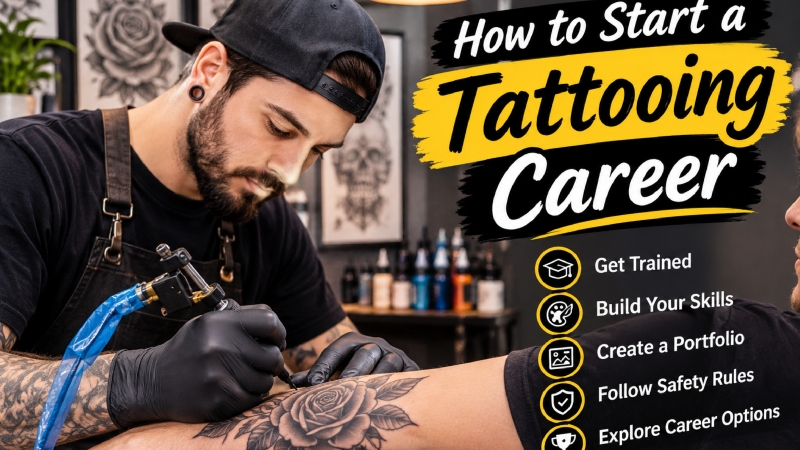
Have you ever imagined turning your artistic talent into a career where your creativity becomes a permanent part of someone’s story? Tattooing offers an exciting opportunity to combine artistic expression, technical skill and meaningful client relationships. However, becoming a professional tattoo artist involves much more than knowing how to draw. It requires patience, dedication, proper training and a strong understanding of professional tattooing practices.
For many aspiring artists, a tattoo apprenticeship is one of the traditional pathways into the industry. It provides an opportunity to learn from experienced tattoo professionals, understand how a studio operates and gradually develop the practical skills needed to work with clients.
The profession also has an established place in Australia’s personal services industry. According to the Australian Bureau of Statistics’ Occupation Standard Classification for Australia (OSCA), Body Artists, which includes tattooists, are recognised as a distinct occupation under code 461231. The classification identifies consultation, design preparation, tattoo application and skin preparation among the key responsibilities of the profession.
So, what does it take to become a tattoo artist, and how can you begin building the skills needed to succeed?
1. Understand What a Tattoo Apprenticeship Involves
A traditional tattoo apprenticeship is a learning arrangement in which an aspiring tattoo artist develops their skills under the guidance of an experienced professional.
Rather than immediately working independently, beginners gradually learn the different responsibilities involved in tattooing. This can include drawing, preparing designs, understanding equipment, maintaining hygiene standards and observing how experienced artists interact with clients.
The learning process is usually progressive. An apprentice may initially spend considerable time developing their artwork and understanding studio procedures before moving towards practical tattooing exercises.
Depending on the studio and mentor, training may cover:
- Drawing and illustration fundamentals.
- Tattoo design preparation and stencil application.
- Understanding tattoo machines and their components.
- Needle configurations and their appropriate uses.
- Ink selection and colour theory.
- Skin preparation and aftercare.
- Infection prevention and equipment sterilisation.
- Client consultation and communication.
- Studio organisation and professional conduct.
One important thing to understand is that apprenticeships differ between studios. Some provide structured training programmes, while others rely on informal mentoring arrangements.
Before accepting an opportunity, clarify the expected responsibilities, learning outcomes, supervision arrangements and any costs involved.
2. Develop Your Drawing and Artistic Skills
A strong artistic foundation is one of the most valuable assets for an aspiring tattoo artist.
Although tattooing involves specialised equipment and techniques, drawing remains central to the profession. Artists must understand how to create designs that translate effectively onto the human body.
You do not necessarily need to be an exceptional illustrator before beginning your training. However, you should be willing to practise consistently and develop your understanding of different artistic styles.
Start by working on these essential skills:
- Linework: Practise creating clean, controlled lines with consistent thickness.
- Shading: Learn how light and shadow create depth and dimension.
- Colour theory: Understand how colours complement one another and how they work together in a design.
- Composition: Develop the ability to arrange visual elements into balanced artwork.
- Proportions: Learn how to maintain accurate proportions when drawing people, animals and objects.
- Perspective: Understand how shapes and objects appear from different angles.
- Illustration: Experiment with different subjects, patterns and artistic approaches.
It is also helpful to explore established tattoo styles, such as traditional, neo-traditional, realism, Japanese-inspired designs, blackwork, fine-line and illustrative tattooing.
You may eventually discover that you have a natural interest in a particular style. Developing a recognisable artistic direction can help distinguish your work from other tattoo artists.
Remember that drawing is a skill that improves with practice. Building a strong portfolio of original artwork can also help demonstrate your potential when approaching tattoo studios.
3. Build a Portfolio Before Approaching Tattoo Studios
If you want to secure an apprenticeship, you need to show potential mentors what you can do.
A portfolio is a collection of your best artwork that demonstrates your creativity, technical ability and willingness to learn. It gives studio owners and experienced tattooists an opportunity to evaluate your artistic foundation.
Instead of including every drawing you have created, focus on presenting your strongest and most relevant work.
Your portfolio could include:
- Original tattoo-inspired designs.
- Black-and-grey illustrations.
- Colour artwork demonstrating your understanding of colour theory.
- Detailed line drawings.
- Realistic illustrations and shading exercises.
- Flash sheets featuring several original tattoo designs.
- Artwork demonstrating different styles and techniques.
Quality is more important than quantity. A smaller collection of well-executed designs can make a stronger impression than a large portfolio containing unfinished or repetitive work.
Presentation also matters. Arrange your artwork neatly, use clear photographs or high-quality digital scans, and include your name and contact details.
If you have a digital portfolio, consider creating a dedicated website or professional social media account where potential mentors can easily review your work.
Most importantly, make sure the artwork is genuinely yours. Copying another tattoo artist’s designs will not demonstrate your individual creativity or ability to develop original concepts.
4. Find the Right Tattoo Studio and Mentor
Finding a suitable mentor is one of the most important steps in pursuing a traditional apprenticeship.
Not every tattoo studio offers apprenticeship opportunities, so you may need to research different businesses and approach artists whose work aligns with your interests.
Start by identifying established tattoo studios in your area. Review their portfolios, customer feedback, social media activity and professional reputation.
When evaluating a potential mentor, consider:
- Experience: Look for an artist with a substantial understanding of tattooing and studio operations.
- Artistic quality: Choose someone whose work demonstrates strong technical ability and consistency.
- Professional standards: Pay attention to how the studio maintains cleanliness and handles client safety.
- Teaching approach: Find someone who is willing to explain techniques and provide constructive feedback.
- Communication: A good mentor should communicate expectations clearly and treat apprentices professionally.
- Learning opportunities: Consider whether the studio offers meaningful exposure to different aspects of tattooing.
Avoid choosing a studio simply because it promises a quick route to becoming a tattoo artist.
A worthwhile learning environment should prioritise education, supervision and safe working practices rather than rushing beginners into performing procedures.
It is also important to discuss the arrangement before committing. Ask about working hours, responsibilities, fees, equipment requirements and whether there is a written agreement.
5. Learn About Tattoo Equipment and Its Proper Use
Understanding tattoo equipment is another essential part of becoming a professional artist.
Tattoo machines are specialised devices that move needles rapidly to deposit ink into the skin. However, using them safely and effectively requires knowledge of their components, settings and maintenance requirements.
Some commonly used equipment includes:
- Tattoo machines: Available in different designs, including rotary and coil machines.
- Needle cartridges: Disposable components containing different needle configurations.
- Tattoo inks: Professional pigments used to create outlines, shading and colour.
- Power supplies: Devices that provide controlled electrical power to compatible machines.
- Grips: Components that help artists hold and control their machines.
- Stencil supplies: Products used to transfer approved designs onto the skin.
- Protective barriers: Covers that help prevent contamination of equipment and work surfaces.
- Cleaning supplies: Products used to maintain appropriate hygiene standards.
An apprenticeship can provide valuable exposure to how these tools are selected, prepared, handled and maintained.
You should also learn the difference between single-use and reusable equipment. Items intended for single use must not be reused, while reusable instruments must undergo appropriate cleaning and sterilisation procedures.
Never experiment with tattooing on yourself or other people before receiving suitable instruction and meeting applicable legal and safety requirements.
6. Understand Hygiene and Infection Control
Tattooing involves penetrating the skin, which means infection prevention is one of the most important responsibilities of a professional tattoo artist.
Poor hygiene practices can expose clients and workers to bloodborne viruses and bacterial infections. Even equipment that appears clean may carry contamination if it has not been properly processed.
In Australia, tattoo studios must follow applicable state and territory public health requirements.
For example, NSW Health explains that tattooing businesses must follow skin penetration requirements under the Public Health Regulation 2022.
These requirements include:
- Ensuring instruments that penetrate the skin are sterile before use.
- Using appropriate cleaning and sterilisation procedures.
- Wearing clean protective clothing and single-use gloves.
- Practising proper hand hygiene.
- Maintaining clean treatment areas and equipment.
- Disposing of needles and other sharps safely.
- Managing clinical waste appropriately.
- Keeping equipment in good working condition.
An apprentice should understand the difference between cleaning, disinfection and sterilisation. These are not interchangeable processes, and each serves a different purpose in infection prevention.
For further information, refer to the official NSW Health guidelines for body art and tattooing businesses.
Understanding these procedures is not simply about passing an assessment. It is about protecting clients, maintaining professional standards and developing responsible working habits from the beginning of your career.
7. Learn How to Create Tattoo Designs for Different Clients
Tattooing is both an artistic and collaborative process.
Clients often approach tattoo artists with an idea, reference image or personal story they want translated into a design. Your role is to understand their expectations and develop artwork that suits their preferences and the intended placement.
This requires good communication, creativity and the ability to adapt your artistic approach.
For example, a client may request a detailed floral tattoo for their forearm. You will need to consider the available space, proportions, level of detail and how the design will follow the natural contours of the body.
Some important design considerations include:
- Body placement and available skin area.
- Overall size and proportions.
- Line thickness and detail.
- Colour combinations and contrast.
- The client’s preferred artistic style.
- How the design will appear from different angles.
- Whether the design is suitable for the intended placement.
You should also understand how tattoos may change in appearance as skin ages and how certain design details may require adjustments to remain visually clear.
Learning to create custom artwork helps develop your identity as an artist while ensuring that clients receive designs that reflect their ideas.
8. Develop Professional Communication and Client Consultation Skills
Being a talented artist is important, but professional communication is equally valuable.
Tattoo artists work closely with clients throughout the design and application process. They must understand client expectations, explain procedures and provide appropriate guidance.
A professional consultation generally involves discussing:
- The client’s preferred tattoo design.
- The meaning or inspiration behind the artwork, where relevant.
- The intended body placement.
- The approximate size and complexity.
- Colour preferences and artistic considerations.
- Relevant health and safety questions.
- Pricing, appointment arrangements and expected treatment time.
It is also important to know when to decline or postpone a procedure. If a client has a condition or circumstance that may affect their suitability for tattooing, follow the studio’s policies and relevant health guidance.
Professional communication continues after the tattoo is completed.
Clients should receive clear aftercare instructions covering cleaning, protection and the expected healing process. They should also understand when to seek medical advice if they notice signs of infection or other complications.
Good client relationships are built on honesty, respect, clear communication and consistent service.
9. Understand Australian Tattooing Regulations
If you plan to become a tattoo artist in Australia, it is essential to understand that requirements vary between states and territories.
Completing an apprenticeship does not automatically mean you can legally work as an independent tattooist.
Depending on your location, you may need to meet licensing, registration, training, infection control and business requirements.
For example:
- Queensland: Tattooists must obtain the appropriate licence. Applicants must meet eligibility requirements and provide evidence of relevant infection prevention competency, including HLTINF005.
- New South Wales: Tattooists performing body art procedures must hold the required tattooist licence, including when working as an apprentice.
- Victoria: Tattooing businesses must comply with relevant registration and infection prevention requirements under public health legislation.
- Other states and territories: Different regulatory arrangements may apply, so check with the relevant health department and local council.
For official information, visit the Queensland Government tattooist licensing requirements.
You should also check whether you need additional qualifications in infection prevention for skin penetration treatments.
Understanding these obligations early can help you make informed decisions about your training and future career.
10. Build Experience and Develop Your Own Tattooing Style
As your training progresses, you will gradually gain a better understanding of your strengths and artistic preferences.
Some artists enjoy creating detailed black-and-grey realism, while others prefer traditional designs, fine-line work or bold illustrative tattoos.
There is no need to settle on a particular style immediately. Exploring different techniques can help you discover what you enjoy and where your abilities are strongest.
To continue developing:
- Practise drawing regularly.
- Study established tattoo artists and their techniques.
- Build a collection of original designs.
- Ask experienced artists for constructive feedback.
- Learn from mistakes instead of repeating them.
- Keep records of your progress.
- Attend relevant tattoo conventions and industry events.
- Continue learning about new equipment and professional practices.
Developing your own artistic identity takes time. Avoid comparing your early work with the finished portfolios of experienced tattoo artists.
Instead, focus on measurable improvements in your drawing, design preparation, technical understanding and professional conduct.
11. Explore Career Opportunities in the Tattoo Industry
Once you have developed the necessary skills and met the relevant requirements, several career opportunities may become available.
Working in an established tattoo studio
Joining an existing studio can provide opportunities to work alongside experienced professionals and develop your client base.
Becoming a specialist tattoo artist
You may choose to focus on a particular style, such as realism, traditional tattooing, blackwork or fine-line designs.
Opening your own tattoo studio
Experienced tattoo artists may eventually consider establishing their own business. This involves additional responsibilities, including business registration, premises requirements, insurance, equipment and compliance with local health regulations.
Becoming a guest tattoo artist
Some experienced professionals work with different studios or travel to attend tattoo events, allowing them to meet new clients and collaborate with other artists.
Developing a personal brand
Social media and digital portfolios can help artists showcase their work, communicate with clients and build recognition within the tattoo community.
Whichever direction you choose, remember that artistic ability must be supported by professional responsibility, business knowledge and a commitment to client safety.
12. Choose the Right Learning Path for Your Goals
Traditional studio apprenticeships are not the only way to begin learning about tattooing.
Today, aspiring artists can explore different educational options, including structured courses, workshops, online learning resources and practical mentoring.
Each approach has its own advantages.
A traditional apprenticeship offers direct exposure to studio operations and mentorship from an experienced artist. A structured educational course may provide a more organised introduction to tattoo theory, equipment, techniques and industry expectations.
Some learners may benefit from combining formal education with supervised practical experience.
Before choosing a learning pathway, consider your existing artistic ability, available time, budget and long-term career goals.
You can also explore the differences between formal training and traditional studio learning in this comparison of tattoo artist courses and traditional apprenticeships.
The best approach is one that gives you a strong educational foundation while helping you understand the professional and safety responsibilities of tattooing.
Watch and Learn: Tattoo Artist Training
Visual demonstrations can help aspiring artists understand the creative and technical aspects of tattooing.
YouTube offers educational content covering drawing techniques, tattoo machine fundamentals, stencil preparation and professional studio practices.
Here is a useful starting point:
Watch tattoo apprenticeship and beginner tattoo artist training videos on YouTube
Use these resources to supplement your learning rather than treating online demonstrations as a substitute for supervised instruction, practical competency and infection control training.
Start Building Your Future in Tattooing
Becoming a tattoo artist is a journey that requires more than artistic talent. It takes patience, discipline, technical development and a genuine commitment to learning.
From creating original artwork and understanding tattoo equipment to mastering hygiene procedures and building professional relationships, every stage contributes to becoming a responsible and capable artist.
A tattoo apprenticeship can be an important part of that journey, particularly for aspiring artists who value hands-on learning and guidance from experienced professionals.
The key is to choose your learning pathway carefully, develop your artistic foundation and never compromise on safety or professional standards.
Whether you dream of working in a respected tattoo studio, developing a signature artistic style or eventually opening your own business, the first step is investing in your knowledge and skills.
Are you ready to turn your passion for drawing and creativity into a future in the tattoo industry? Start exploring your training options and take the first step towards becoming a professional tattoo artist.

Erin Durkheim is an author and content contributor at Gingerbread Nails, covering nail designs, nail care, beauty tips, fashion, and product-related topics. She focuses on creating practical, easy-to-understand content that helps readers explore nail trends, care routines, and everyday beauty ideas.