
Natural Skincare Ingredients Guide: Let me be honest with you.
For years, I assumed that if a skincare product had a long, unpronounceable name and a hefty price tag, it must be good for my face. I was wrong. The beauty industry has sold us the idea that synthetic chemicals are the only things strong enough to fix our skin. But more and more people—myself included—are realizing that their skin feels worse after using those harsh lab-born potions. Redness. Peeling. Breakouts. Sound familiar? That’s why so many of us are turning back to natural skincare ingredients.
These are ingredients derived from plants, minerals, and other natural sources. They’re rich in vitamins, antioxidants, and essential nutrients that work with your skin, not against it. But here’s the catch—and it’s a big one. The word “natural” on a bottle means almost nothing legally. A company can slap a green leaf on a package, fill it with synthetic junk, and call it a day. Worse, some natural ingredients (such as certain essential oils) can burn your skin or trigger allergies.
So how do you tell the difference between real plant power and pretty marketing?
That’s exactly what this guide is for. I’ve dug through the research, looked at what dermatologists are actually saying, and tested a bunch of this stuff myself. Below, I’m sharing seven natural skincare ingredients that are backed by real science, not just Instagram trends.
Why People Are Ditching Synthetics for Plants
Walk into any skincare aisle today, and you’ll see shelves overflowing with “clean,” “green,” and “organic” labels. This isn’t just a fad. According to research published in Process Biochemistry, plant-based cosmetics are genuinely less toxic than many synthetic alternatives. They contain antioxidants and anti-inflammatory compounds that help your skin fight damage without the side effects.
But let’s pump the brakes for a moment.
Just because something grows out of the ground doesn’t mean it’s gentle. Poison ivy is natural. So is arsenic. Some plant oils—like cinnamon or bergamot—can cause serious irritation or even chemical burns when you go out in the sun. The trick is knowing which natural skincare ingredients are actually safe, stable, and effective. That’s what we’re covering today.
The “Teamwork” Effect of Plants
Here’s something most people don’t realize.
When you take a synthetic vitamin C serum, you’re getting one isolated molecule. It works, sure, but it’s unstable and often causes noticeable irritation. When you use a natural source of vitamin C—like amla fruit or rose hips—you get a whole team of compounds: flavonoids, tannins, and co-factors that help the vitamin C work better and cause less irritation.
That’s the real magic of natural skincare ingredients. They work together.
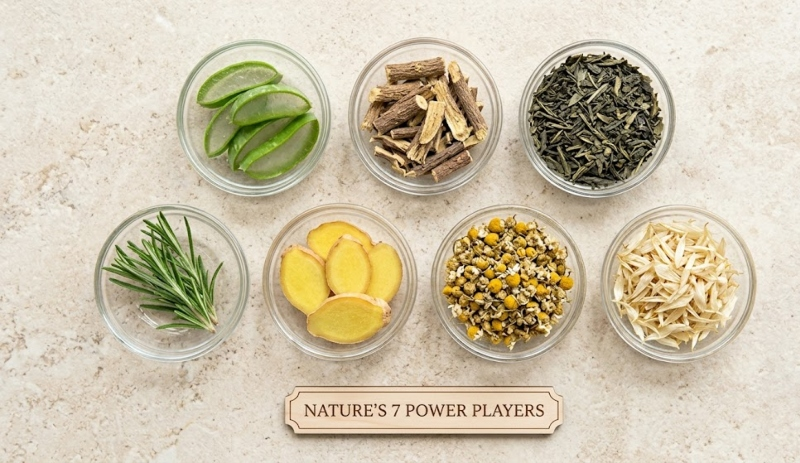
7 Natural Skincare Ingredients That Actually Deliver
Use this cheat sheet when you’re shopping. Keep it on your phone. Compare it to labels.
| Ingredient | Key Active | What It Does | Best Skin Type |
| Aloe Vera | Polysaccharides | Heals, hydrates, calms burns | Dry, sunburned, inflamed |
| Green Tea | EGCG (antioxidant) | Fights aging, reduces redness | Oily, aging, acne-prone |
| Safflower Oil | Linoleic acid | Unclogs pores, balances oil | Oily, acne-prone, eczema |
| Chamomile | Bisabolol | Soothes irritation | Sensitive, rosacea, dermatitis |
| Licorice Root | Glabridin | Fades dark spots | Hyperpigmentation, melasma |
| Rosemary | Carnosic acid | Fights bacteria, firms skin | Aging, dandruff, scalp issues |
| Ginger Root | Gingerols | Brightens dull skin | Uneven texture, dullness |
Let’s Get Specific: How Each Ingredient Works
A table is nice, but you need to know how to use it. Let’s walk through them one by one.
Aloe Vera: The Hydration Hero
If you’ve ever snapped an aloe leaf open and rubbed the goo on a sunburn, you already know this works. But here’s what most people miss: the magic is in the polysaccharides—big, sugar-like molecules that lock in moisture with remarkable efficiency.
A study in the International Journal of Molecular Sciences confirmed that aloe doesn’t just moisturize. It actually speeds up wound healing and reduces UV damage.
What to look for: Aloe should be in the first three ingredients. Avoid anything that says “aloe powder” or has alcohol high up on the list—alcohol destroys the active compounds.
Real-talk warning: That bright green aloe gel from the drugstore? It’s usually dyed and full of preservatives. Go for clear or colorless gels.
Green Tea: Your Daily Antioxidant Shot
You already drink it. Why not put it on your face? Green tea’s claim to fame is EGCG, an antioxidant that studies show is roughly 20 times more powerful than vitamin E at neutralizing free radicals. It’s been shown to help with everything from sun damage to acne to eczema.
DIY trick that actually works: Brew two green tea bags, let them cool completely in the fridge, then lay them over your eyes for ten minutes. The caffeine shrinks blood vessels (goodbye, puffiness), and the EGCG fights under-eye aging.
What to buy: Look for serums with green tea extract high on the list. Avoid products where it’s buried at the bottom.
Safflower Oil: The Secret for Oily Skin
This one confuses people. If you have oily skin, the last thing you want to do is put oil on your face, right? Wrong.
Here’s the truth: your skin produces oil (sebum) regardless. If you strip it all away with harsh cleansers, your skin panics and makes even more oil. The solution? Give it the right kind of oil.
Safflower oil is packed with linoleic acid, which is exactly what oily and acne-prone skin is missing. Studies show that people with acne have lower levels of linoleic acid in their skin. When you apply safflower oil, your skin basically says, “Oh, we’re good here,” and slows down its own oil production.
How to use it: As a first cleanse at night. Massage it onto dry skin to melt makeup and sunscreen, then wipe off with a warm washcloth.
Chamomile: The Skin Calmer
This tea helps you sleep. Chamomile on your skin helps you stop looking like a tomato. The active compound here is bisabolol. It’s been studied for the treatment of eczema and atopic dermatitis. Unlike steroid creams, which can have side effects, chamomile works gently.
Who should use it: Anyone with rosacea, redness, or sensitivity.
Who should avoid it: People with ragweed allergies. Chamomile is in the same plant family as ragweed, and cross-reactions are common. If you sneeze around ragweed, patch-test chamomile on your arm first.
Licorice Root: The Dark Spot Eraser
Hyperpigmentation is stubborn. Melasma is even worse. And most brightening creams use hydroquinone, which can actually darken your skin over time if you’re not careful.
Licorice root is a different story. It contains glabridin, which blocks tyrosinase—the enzyme your body uses to make melanin. Multiple studies have shown it fades dark spots without irritation.
Best paired with: Vitamin C or niacinamide. They work through different pathways and boost each other.
Rosemary: Not Just for Cooking
Rosemary is having a moment, and for good reason. The carnosic acid in rosemary is a potent antioxidant that also fights bacteria. That makes it useful for two very different things: anti-aging (fighting free radicals) and scalp health (fighting dandruff).
For your face: Look for rosemary in anti-aging serums.
For your scalp: Add a few drops of rosemary essential oil to your shampoo. A 2015 study found it was just as effective as 2% minoxidil (Rogaine) for hair growth, with less itching.
Ginger Root: The Underdog
Nobody talks about ginger in skincare, which is a shame. Gingerols (the compounds that make ginger spicy) are powerful free-radical scavengers. They also improve circulation, which gives dull skin a healthy glow.
Best for: People whose skin looks tired, gray, or uneven.
DIY mask (gentle version): Grate fresh ginger, squeeze out the juice, mix with plain yogurt, and leave on for 5 minutes. Rinse immediately if it stings.
Latest Trends in Natural Skincare (2026)
The beauty industry is evolving fast, and natural skincare ingredients are at the center of several exciting trends:
- Clean Beauty: Products with short, transparent ingredient lists. No hidden “fragrance” loopholes.
- Fermented Skincare: Fermented plant extracts are more easily absorbed by your skin. Think fermented green tea or rice water.
- Adaptogens: Herbs like ashwagandha and reishi that help your skin handle stress (yes, stress shows up on your face).
- Minimal Skincare (“Skinimalism”): Fewer products, better results. Three well-chosen natural products beat a ten-step routine full of fillers.
These trends prove that natural skincare ingredients aren’t just old-fashioned remedies. They’re the future.
The Hard Truth: Natural Doesn’t Mean Risk-Free
I have to say this because nobody else will. The “chemical-free” movement is a lie. Water is a chemical. Air is a chemical. Everything is a chemical. The real danger is when companies skip preservatives to look “natural.” Without preservatives, water-based products turn into petri dishes for mold and bacteria. You could end up with a serious skin infection.
Also: Some natural ingredients are straight-up dangerous.
- Bergamot oil + sunlight = chemical burns.
- Cinnamon oil = burns on contact for many people.
- Tea tree oil = common allergen.
Always, always patch-test new natural skincare ingredients on your inner arm for five days before putting them on your face.
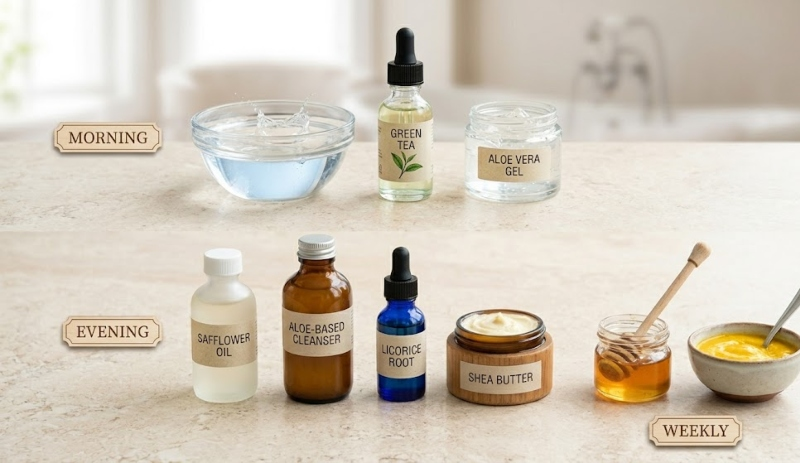
A Simple Routine Using Natural Ingredients
You don’t need fifteen steps. Here’s a straightforward routine using the ingredients we just covered.
Morning (protect and prep)
- Rinse with cool water (no cleanser if your skin is dry).
- Green tea serum (antioxidants for pollution and UV).
- Aloe vera gel as a moisturizer.
- Sunscreen. This is non-negotiable. Zinc oxide is natural and works great.
Evening (clean and repair)
- Safflower oil to remove makeup and sunscreen.
- Gentle aloe-based cleanser.
- Licorice root serum (for dark spots) OR rosehip oil (for wrinkles).
- Shea butter or mango butter to lock everything in.
Weekly (optional but nice)
- Honey mask: Apply raw honey to clean skin for 10 minutes. Antibacterial and softening.
- Turmeric + yogurt mask: Brightening and anti-inflammatory. Rinse well (turmeric stains).
Pro Tips for Better Results
- Always do a patch test before trying new products.
- Choose ingredients based on your skin type, not hype.
- Stay hydrated and eat whole foods. Skincare starts from the inside.
- Avoid overusing products, even if they are natural. More is not better.
Common Mistakes to Avoid
Many people think “natural” means 100% safe. That is not true. Overusing oils or mixing too many active ingredients can harm your skin. Use natural skincare ingredients wisely and in the right amount.
Also, don’t fall for the “no preservatives” marketing trick. Without preservatives, your product becomes a science experiment—and not the good kind.
One External Resource to Bookmark
If you want to go deeper, the Environmental Working Group (EWG) keeps a massive, searchable database of cosmetic ingredients. They rate safety and cite the actual studies. You can find it at ewg.org/skindeep. It’s free, and it’s saved me from buying a lot of overpriced junk.
Frequently Asked Questions
Q1: Are natural skincare ingredients better for sensitive skin?
Not always. Chamomile and aloe are great, but natural essential oils (peppermint, ylang-ylang, citrus) are common irritants. Sometimes a simple synthetic moisturizer is safer than a complex plant blend.
Q2: How do I keep natural products from going bad?
Water + plants = bacteria. Look for products that use natural preservatives (like radish root ferment) or buy oil-based products (which don’t need preservatives). Keep them out of the bathroom—heat and humidity speed up spoilage.
Q3: Can natural ingredients help hormonal acne?
Yes, but don’t expect miracles. Safflower oil helps unclog pores. Tea tree oil fights bacteria. But severe hormonal acne usually needs a doctor’s help alongside natural topicals.
Q4: What’s the natural version of retinol?
Bakuchiol. It comes from the babchi plant. Multiple studies show it works as well as retinol for wrinkles and pigmentation, but without the redness, peeling, and sun sensitivity. A genuine win-win.
Q5: Why does my “natural” product burn?
Three possibilities:
- You’re allergic to a plant family (ragweed allergy + chamomile).
- The pH is too low (too much citrus or fruit acid).
- It’s expired, and bacteria have taken over.
Patch test. Always. And if it burns, wash it off immediately and don’t try to “push through.”
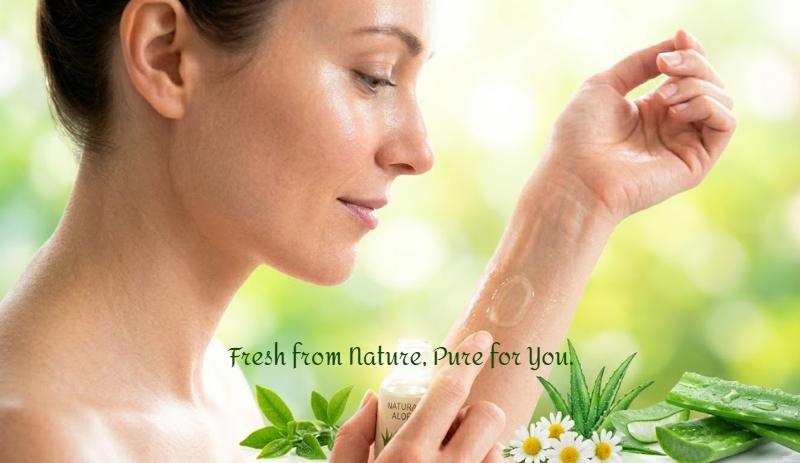
Final Thoughts: Nature + Common Sense
Here’s where I land after years of trial and error.
Natural skincare ingredients are powerful. They’re often gentler than their synthetic cousins. They’re better for the planet. And when you find the right ones for your skin, they work beautifully. But they’re not magic. They’re not automatically safe. And they’re definitely not all created equal.
Read your labels. Look for Latin names (not just “tea” but Camellia sinensis). Avoid undisclosed “fragrance.” Patch test on your face like it depends on it—because it does. The goal isn’t to be 100% natural. The goal is to be smart. Use the best of what nature gives us, respect its limits, and ignore the marketing hype.
Your skin will thank you. And your wallet might, too.
Looking for something specific? Stay connected for exclusive updates and in-depth content.

Erin Durkheim is an author and content contributor at Gingerbread Nails, covering nail designs, nail care, beauty tips, fashion, and product-related topics. She focuses on creating practical, easy-to-understand content that helps readers explore nail trends, care routines, and everyday beauty ideas.