
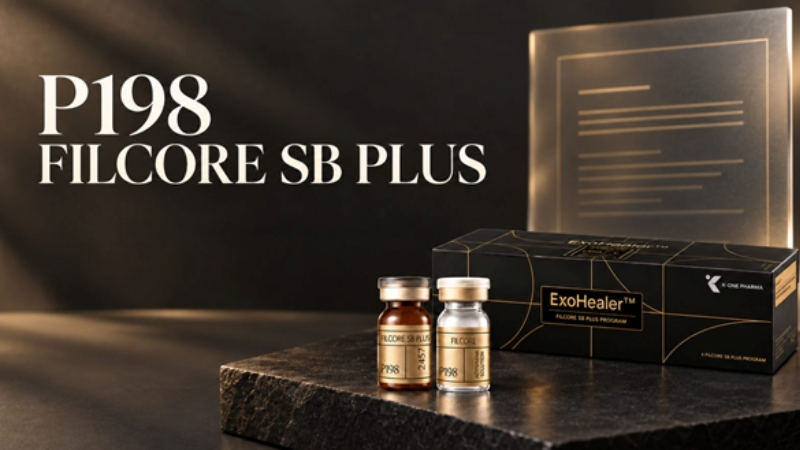
Skin can look tired without needing more volume. A complexion may feel dry, reflect light unevenly, or show fine surface lines while its underlying facial shape remains unchanged. Those concerns help explain the interest in exosome-based skincare: the conversation moves from filling space toward the biology of how skin cells communicate.
The P198 Filcore SB Plus Program belongs to that conversation. Its distinguishing feature is the P198 ExoHealer platform, which the brand associates with umbilical cord blood stem cell conditioned medium. Understanding this ingredient is more useful than memorizing a list of advertised benefits. It explains why the product is discussed in relation to skin quality, how its concept differs from hyaluronic acid, and which expectations make sense when reading about it.
What makes P198 Filcore SB Plus different
P198 describes ExoHealer as exosomes contained in USC1994-CM, its named umbilical cord blood stem cell conditioned medium. The SB Plus program presents this material in a lyophilized format accompanied by a solvent. Its identity therefore centers on a cell-derived ingredient system, rather than a conventional gel designed to add structural volume.
The phrase “conditioned medium” sounds technical but has a straightforward meaning. Cells are grown in a controlled liquid environment; during that process, they release substances into the surrounding medium. The resulting material can contain extracellular vesicles alongside soluble components. Conditioned medium is consequently a broader mixture than an isolated population of purified exosomes.
The soluble and vesicle-associated portions have different physical forms. A soluble protein can exist in the surrounding liquid without a membrane enclosing it. A vesicle is a separate membrane-bounded structure, with molecules inside it and associated with its surface. Collecting conditioned medium and isolating vesicles from that medium are consequently different operations. The first describes the broader material; the second separates a fraction from it.
This is the important meaning of P198’s USC1994-CM identity. Its brand language points to a conditioned-medium system that includes exosomes, not a single chemically defined molecule. Describing the source as umbilical cord blood tells the reader where the producing cells originated. The material released by those cells is distinct from the cells themselves: a cell-derived skincare ingredient is not a living-cell transplant.
It also explains why an ingredient percentage and an exosome percentage cannot be substituted for each other. The proportion of a conditioned-medium ingredient describes how much of that ingredient enters a formula. It does not identify the proportion occupied by vesicles, the proteins associated with them, or a particular RNA. Those are different features of the material, just as the amount of a fruit extract does not specify the amount of every molecule within it.
How exosomes participate in cellular communication
Extracellular vesicles are small particles enclosed by a lipid membrane and released by cells. Exosomes are a particular subgroup defined by their origin within the cell. Their contents can include proteins, lipids, and RNA, and their interactions with other cells help explain the scientific interest in them.
A useful analogy is a package carrying messages. The lipid membrane provides the envelope, separating an internal compartment from the surrounding liquid. Proteins can form part of the surface or cargo, while RNA represents another kind of biological information. These components are not interchangeable: the membrane organizes the particle, while the molecules associated with it contribute to how it interacts with its environment.
“RNA” is itself a category, not the name of one rejuvenating substance. Messenger RNA carries information used in protein production, while microRNAs participate in regulating gene expression. Exosome research asks whether particular cargo reaches recipient cells and changes their behavior. Listing these molecular categories explains the research concept; it does not establish which RNA molecules are present or active in an individual P198 vial.
This distinction separates a biological mechanism from a beauty promise. “Cell communication” describes a process. “Smoother-looking skin” describes a visible outcome. To connect the two, a finished formulation must be studied in the circumstances in which it is used. An attractive explanation of the first cannot substitute for observation of the second.
Source cells and their growth environment influence what is released into the medium. The medium is therefore the result of a biological process, not merely water to which identical particles have been added. P198 names its own cell-derived platform; research on another platform remains relevant to the wider science without defining the contents of this one.
Texture hydration and firmness are different goals
P198’s positioning concerns skin quality: surface texture, complexion, and related appearance concerns. These outcomes should remain distinct. Hydration describes moisture; texture concerns the surface; firmness concerns how skin responds mechanically. Improvement in one does not establish improvement in all three, and none is automatically equivalent to the structural volume provided by a filler. That distinction gives the biological concept a clear place without making it a claim to change facial shape.
How the concept compares with hyaluronic acid and antioxidants
Hyaluronic acid is especially familiar because of its capacity to retain water. Its role in skin moisture is well established, although the behavior of any skincare product still depends on its formulation. The exosome concept starts elsewhere: with cell-derived material and its potential biological interactions. Both categories may be discussed around skin quality, but that overlap does not make their mechanisms identical.
Antioxidants introduce a third idea. Their chemistry concerns oxidation reactions, rather than the water-binding function associated with HA or the vesicle-mediated communication studied in exosome biology. A product can include several ingredient approaches, but the word exosome does not automatically mean it supplies every benefit associated with an antioxidant serum.
| Approach | Central product idea | The customer question it helps clarify |
| P198 Filcore SB Plus | Conditioned-medium and exosome-centered professional skincare | What does a cell-derived ingredient system contribute to a skin-quality discussion? |
| HA-focused skincare | Water retention within a particular formulation | Is moisture and a less dry-looking surface the main goal? |
| Antioxidant skincare | Ingredients that participate in oxidation-related chemistry | What active ingredient and formulation support the claimed benefit? |
| Volumizing HA filler | A gel designed to provide physical support and volume | Is the concern facial shape rather than the appearance of the skin surface? |
The table is a comparison of concepts, not a ranking of effectiveness. Someone interested in P198 does not need to conclude that familiar moisturizers are outdated. The useful question is what extra role a professional product is intended to play alongside an existing routine, rather than whether one fashionable ingredient can replace every other category.
What human research can tell us?
A 2023 randomized split-face study by Park and colleagues examined an adipose-derived exosome-containing solution used alongside microneedling in 28 participants. Over 12 weeks, the treated side showed greater improvements than the control side in several measurements, including wrinkles, elasticity, hydration, and pigmentation.
That is relevant because it moves the broader discussion beyond laboratory explanations into measured human skin outcomes. It also gives the reader a clear boundary: the study used an adipose-derived preparation and a combined intervention. It did not test P198 Filcore SB Plus, whose brand description identifies a different source material.
The sensible takeaway is interest with specificity. The paper supports further investigation of exosome-containing formulations in aesthetic skincare; it cannot supply a P198 success rate, a guaranteed duration, or an identical expected response. Those would be different questions requiring evidence about the named finished product.
This is also why a long list of possible benefits can be less informative than a shorter explanation of the product’s purpose. If texture is the main concern, evidence about texture is more useful than unrelated claims about every aspect of aging. A focused discussion allows P198’s biological concept to remain interesting without expanding it into a universal solution.
Why the program contains two components
The official SB Plus program pairs a lyophilized component with a solvent and describes five pairs in its presentation.[1] Lyophilized means freeze-dried: the supplied material is presented in a dried form rather than as an ordinary ready-to-use serum. The separate solvent completes the professional product system. This format should not be confused with two different biological treatments; the components belong to one program. The powder’s appearance also cannot reveal the individual vesicles, proteins, or other constituents discussed in the product’s scientific background.
Frequently asked questions
Is P198 Filcore SB Plus a treatment with living stem cells
Its brand identity centers on conditioned medium and exosomes, which are different from a living-cell preparation. “Stem cell-derived” describes the source of certain materials. It should not be read as meaning the product implants replacement stem cells into the skin or permanently rebuilds it.
Is an exosome the same thing as a growth factor
No. An exosome is a membrane-enclosed vesicle; a growth factor is a signaling molecule. A conditioned-medium system can contain multiple types of components. Using the terms interchangeably removes useful information about what the material is and how the proposed biology is being described.
Will it add volume like a dermal filler?
That is not the role discussed for this program. P198 is positioned around skin quality, whereas a volumizing filler is selected for a physical gel effect. A person seeking a change in facial contour has a different objective from someone seeking a more refined-looking surface.
Is it automatically better than an HA skin product
No single ingredient category wins for every goal. HA’s moisture-related role and the biological concept behind conditioned-medium products address different questions. The useful comparison starts with the concern, the complete formulation, and evidence for that particular product rather than the novelty of its headline ingredient.
Can results from other exosome products predict my P198 results
They can explain why the category attracts research interest, but cannot provide an individual forecast. Different source cells, formulation methods, and study conditions matter. The Park study discussed above is informative about its tested combination, rather than a clinical performance claim for P198.
What would a useful consultation about this product cover
Begin with the change you want to see: texture, overall appearance, or another clearly described concern. Ask the professional to explain why this particular product fits that goal and how progress would be assessed. A precise explanation is more valuable than a promise of complete rejuvenation.
Explore the product with a clear skin quality goal
P198 Filcore SB Plus is most interesting when its cell-derived ingredient concept is explained clearly. The central questions concern what the formula represents, how the exosome concept differs from hydration or volumizing approaches, and which visible change matters to the individual. To explore the available program and related professional categories, visit MJS Medicals. Bring a defined skin-quality objective to the discussion so the product can be considered in relation to a specific need.
References
[1] Primoris International / P198 ExoHealer. ExoHealer; FILCORE SB PLUS PROGRAM. Official brand and product information. Undated; accessed 2026.
[2] Welsh JA, Goberdhan DCI, O’Driscoll L, et al. Minimal information for studies of extracellular vesicles (MISEV2023): From basic to advanced approaches. Journal of Extracellular Vesicles. 2024.
[3] Kalluri R, LeBleu VS. The biology, function, and biomedical applications of exosomes. Science. 2020.
[4] Park GH, Kwon HH, Seok J, et al. Efficacy of combined treatment with human adipose tissue stem cell-derived exosome-containing solution and microneedling for facial skin aging: A 12-week prospective, randomized, split-face study. Journal of Cosmetic Dermatology. 2023.
[5] Papakonstantinou E, Roth M, Karakiulakis G. Hyaluronic acid: A key molecule in skin aging. Dermato-Endocrinology. 2012.

Erin Durkheim is an author and content contributor at Gingerbread Nails, covering nail designs, nail care, beauty tips, fashion, and product-related topics. She focuses on creating practical, easy-to-understand content that helps readers explore nail trends, care routines, and everyday beauty ideas.