

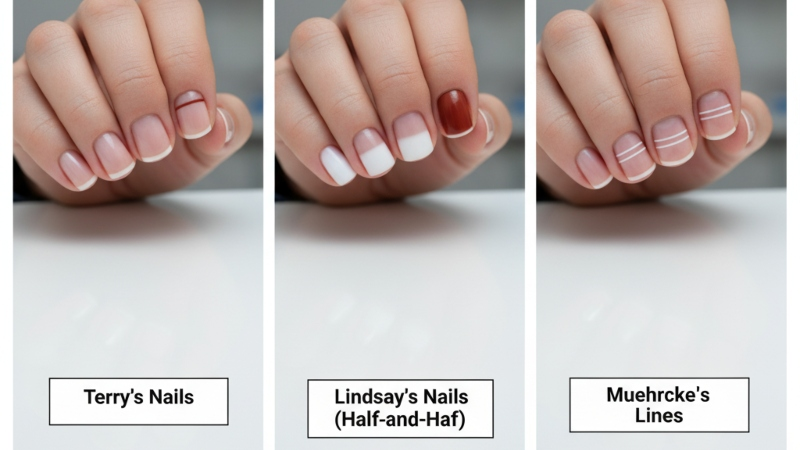
Our nails are not just for looks; they can also show signs of our health. One clear example is Terry’s nails. In this condition, most of the nail looks very pale or “washed out,” with only a thin reddish-brown line at the tip. This differs from normal nail color changes and can be a sign of underlying health problems.
Research shows that up to 80% of people with serious liver disease have Terry’s nails. That’s why noticing this early is important. It’s not only a cosmetic issue; it can help doctors detect diseases early and start the right treatment. In this article, you will learn everything about Terry’s nail and its treatment.
What are Terry’s nails?
Terry’s nails are a nail condition in which most of the nail appears white or cloudy, with only a thin pink or brown line visible at the tip. Normally, under the nail there is a small white half-moon (called the lunula), but in Terry’s nails it disappears. This usually happens on almost all fingernails, and sometimes it can also appear on toenails. Terry’s nails do not cause pain or discomfort on their own, but they are often a sign of a larger health problem in the body. Sometimes they develop only with age, but if they appear at a young age or alongside other health issues, it is important to see a doctor.
Why Do Terry’s Nails Occur?
Researchers believe Terry’s nails result from changes in the blood supply under the nail bed. Specifically:
- Reduced blood vessels → less pink color
- Increased connective tissue → cloudy or pale nail appearance
These changes are usually linked to systemic disease, though aging alone can also produce a similar look.
Who founded Terry Nails and when?
Terry’s nails are named after a doctor called Dr Richard Terry. He was the first to notice this nail change while treating patients with liver disease in the 1950s. Since then, doctors have recognized Terry’s nails as an important sign that can indicate hidden, serious health problems in the body.
Terry’s Nail causes and symptoms
Terry’s nails develop when the blood supply to the nail decreases and extra skin-like tissue (connective tissue) forms there. This causes the nail to lose its normal pink color and appear white or cloudy.
Sometimes this can happen with aging alone, but often it is a sign of a serious disease. Terry’s nails are most commonly seen in liver diseases like cirrhosis or hepatitis. They can also be caused by kidney failure, heart failure, diabetes, and malnutrition.
In some cases, they are also seen in HIV, tuberculosis, leprosy, or blood circulation problems (peripheral vascular disease). In simple terms, Terry’s nails appear when blood flow or the body’s organs are not working properly.

When to go to see a doctor?
If your nails suddenly turn white with only a thin brown or pink line at the tip, you should see a doctor. Sometimes this happens just because of aging, but often it can be a sign of liver, kidney, or heart disease.
If you also have other symptoms like tiredness, jaundice (yellow eyes or skin), or swelling, then a check-up becomes even more important. Only a doctor can confirm whether Terry’s nails are due to normal aging or a serious health problem.
What might doctors mistake for Terry’s nails?
Sometimes doctors may mistake Terry’s nails for other nail problems because a few conditions can also cause nails to look white or discolored.
- In Lindsay’s nails (half-and-half nails), the upper half of the nail looks white, and the lower half looks brown.
- In Muehrcke’s nails, there are parallel white lines across the nails.
- In true leukonychia, the nails may look fully white (totalis) or partly white (partialis).
Since these can resemble Terry’s nails, a proper check-up and accurate diagnosis are very important to determine the real cause.
How to Treat Terry’s Nails?
Terry’s nails do not receive any special treatment. They happen because of health problems. That’s why doctors first treat the main disease.
- In liver cirrhosis, treatment may include avoiding alcohol, controlling diet, and, in advanced cases, a liver transplant.
- In cases of kidney disease, patients may need dialysis or a kidney transplant.
- In heart failure, doctors recommend medicines, surgery, and lifestyle changes.
- If the cause is malnutrition, doctors recommend a diet rich in protein and vitamins (such as iron and vitamin B12).
If Terry’s nails are only due to aging, then no treatment is needed. Just normal nail care is enough.
How to treat Terry’s nails at home?
Terry’s nails cannot be treated at home, as they are usually a sign of another health problem. But you can follow some simple home care tips to keep your nails healthy:
- Keep your nails clean and moisturized so they don’t become brittle.
- Wear gloves while washing dishes or cleaning to protect your nails from damage.
- Avoid nail biting and harsh chemicals.
- Eat a healthy diet with enough vitamins to support overall nail health.
The most important point is that if a disease causes Terry’s nails, only a doctor can provide the proper treatment.

Some Nail Tips
You can take small steps at home to keep your nails healthy:
- Always keep your nails clean and moisturized.
- Keep nails short and trimmed to avoid breakage or damage.
- Wear gloves while cleaning or using chemicals.
- Avoid nail biting or picking.
- Eat a healthy diet with enough protein, vitamins, and minerals.
- If the nail’s appearance bothers you, you can use cosmetic coverage, such as nail polish.
How Are Terry’s Nails Diagnosed?
To diagnose Terry’s nails, a doctor first examines them carefully. If there is any doubt, then more detailed tests are done. These may include:
- Blood tests: to check liver, kidney, and sugar levels
- Heart tests: like ECG or echocardiogram
- Imaging scans, such as an ultrasound or a CT scan
- Nutritional tests: to see if there is a lack of protein or vitamins
Since Terry’s nails are often a sign of a serious disease, a proper medical check-up is very important.
Complications of Terry’s Nails
If the disease behind Terry’s nails is not treated, complications can develop, such as:
- The underlying disease is getting worse (for example, liver or kidney problems becoming more severe)
- Permanent nail changes (the nails may be damaged forever)
- Decline in overall health (if the disease is not controlled, the body becomes weaker)
Terry’s Nails vs. Other Nail Disorders
| Feature / Disorder | Terry’s Nails | Lindsay’s Nails | Muehrcke’s Lines | Leukonychia | Nail Clubbing |
|---|---|---|---|---|---|
| Appearance | 80–90% nail white, thin reddish-brown band at tip | Half white, half brown | Paired horizontal white lines | The entire nail or patches are white | Nail curves downward, bulbous fingertip |
| Lunula | Disappears | Maybe visible | Visible but crossed by lines | Can be hidden | Usually visible but distorted |
| Causes | Liver, kidney, heart disease, and aging | Chronic kidney failure | Low albumin (disease, malnutrition) | Trauma, genetics, poisoning | Lung/heart disease |
| Reversibility | Improves if the disease is treated | Improves with dialysis/transplant | Improves if protein is corrected | May or may not improve | Reversible only if the cause is treated |
| Key Sign | Washed-out nails + distal brown band | Distinct half-white, half-brown | Lines don’t move with nail growth | The nail plate turns white | Rounded, thick nails with fingertip swelling |
Endnote
Terry’s nails are a type of nail discoloration in which most of the nail appears white or pale, with a thin brown or reddish band at the tip. This change usually occurs on many fingernails and sometimes on toenails as well.
This condition is not always a sign of disease, because in some people it can appear naturally with aging. But many times, Terry’s nails point to serious health problems like liver disease, kidney issues, heart failure, or diabetes.
That’s why if you notice such changes in your nails, it is very important to consult a doctor. An early check-up can help find and treat hidden diseases in time and keep your overall health better. Remember: Healthy nails are often a sign of a healthy body.
Some questions about Terry’s nails
Let’s discuss important questions about Terry’s nails to deepen our understanding:
1. Are Terry’s nails dangerous?
Not directly, but they often signal serious diseases like liver, kidney, or heart problems.
2. Can Terry’s nails be treated?
There is no direct treatment. They improve only when the underlying health problem (like liver disease or diabetes) is treated.
3. Do Terry’s nails affect all nails?
Mostly yes. They usually appear on most fingernails, and sometimes on toenails too.
4. Can Terry’s nails be hidden with nail polish?
Yes, nail polish or a manicure can temporarily cover them. But this only hides the look; it does not treat the problem.
5. Does vitamin deficiency cause Terry’s nail syndrome?
Not directly. They are more commonly linked to aging or diseases of the liver, kidney, and heart.
Have questions or feedback? For more updates, contact us anytime.

Erin Durkheim is an author and content contributor at Gingerbread Nails, covering nail designs, nail care, beauty tips, fashion, and product-related topics. She focuses on creating practical, easy-to-understand content that helps readers explore nail trends, care routines, and everyday beauty ideas.