
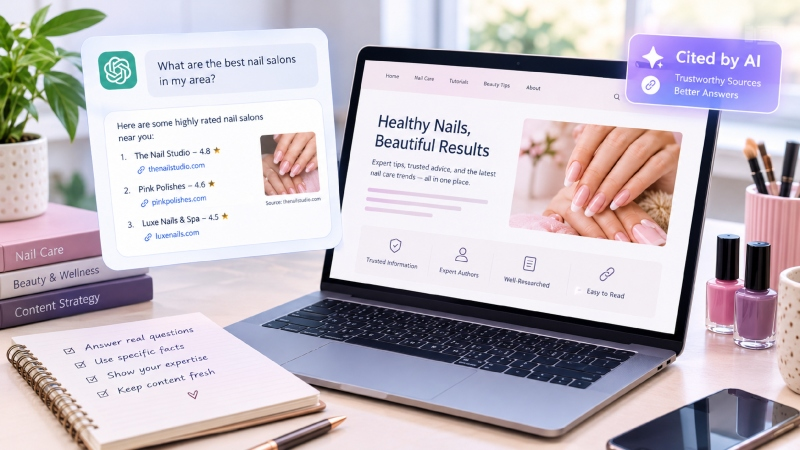
When someone asks an AI assistant for a nail salon recommendation, a manicure idea, or advice on caring for brittle nails, the answer may draw on information from websites rather than simply listing search results. For salons, beauty professionals, and publishers, learning how to optimize websites for ChatGPT citations is becoming part of making useful information easy to find. The goal is not to game a chatbot. It is to publish trustworthy, clear material that can answer real questions.
What Does It Mean to Be Cited by AI?
AI search tools may summarize information from multiple sources and, depending on the product and query, show links or citations alongside their answers. Being cited means a page has been selected as a source for some part of that response. It does not guarantee a particular ranking, a stream of visitors, or inclusion in every answer.
That uncertainty makes sound publishing practices more valuable than tricks aimed at a single platform. A well-organized article can serve readers whether they arrive from a traditional search engine, an AI-generated answer, or a direct recommendation.
Make Each Page Answer a Clear Question
Start with the questions your audience actually asks. A nail artist might explain how long a gel manicure typically lasts, what to consider before choosing a shape, or how to prepare nails for an appointment. A beauty publisher could compare polish finishes or describe how to remove a product safely. Specific questions give a page a clear purpose.
Answer the central question near the beginning, then add the context a reader needs to make a decision. Use descriptive headings for related points, such as maintenance, cost factors, or when to ask a professional. Avoid burying the useful part under a long introduction or repeating the same point in several sections.
Use Specific, Verifiable Information
General claims are difficult for readers to evaluate. Concrete details make advice more useful: explain what a service includes, which factors affect appointment length, or how a recommendation changes for different nail conditions. Distinguish personal experience from general guidance, and support health or safety claims with reliable evidence. When information can change, such as prices or product availability, say when it was last reviewed.
Accuracy also means being candid about limits. A photo cannot always reveal a person’s nail health, and a general article cannot replace individualized professional advice. Clear qualifications help readers understand how far a recommendation applies.
Structure Content for People and Machines
Use plain language, short paragraphs, and headings that accurately describe what follows. Lists can make steps or comparisons easier to scan, but use them only when they improve clarity. Define technical terms the first time they appear. A page should make sense to someone who has not read the rest of your site.
Give important facts their own text rather than hiding them in images, decorative graphics, or video alone. Add descriptive captions and image text where appropriate, and make sure the page works well on mobile. Accessible, readable content helps visitors navigate the page and makes its meaning clearer to automated systems.
Show Who Created and Maintains the Advice
Readers should be able to tell who is responsible for a page and why that person or business is qualified to discuss the subject. Include an author name, relevant experience, and a straightforward way to learn about the organization. For service pages, provide practical details such as location, opening hours, service scope, and how to ask questions.
Review older articles rather than assuming publication is the last step. Correct outdated information, remove unsupported claims, and note meaningful updates. A smaller collection of maintained, genuinely useful pages is often more valuable to readers than a large archive of thin articles written mainly to cover keywords.
Build a Useful Website Beyond the Article
Good content is only one part of the experience. Make pages load reliably, use consistent navigation, and avoid intrusive pop-ups that block the answer. Link related pages together when the connection helps someone continue learning—for instance, a guide to choosing polish might point readers toward a separate explanation of finishes. Keep business details consistent wherever they appear online.
For a fuller overview of how publishers can approach visibility in AI-generated answers, read these AI citation recommendations. Treat any checklist as a starting point, not a promise: AI products change, and their source-selection methods are not fully under a publisher’s control.
When Technical Help May Be Useful
Some website improvements require development work, especially when a business needs a faster site, a content-management upgrade, or a custom tool. Before hiring, define the actual problem, the expected deliverables, and how success will be evaluated. A technical specialist should be able to explain trade-offs in terms a nontechnical owner can understand.
For startups considering machine-learning features rather than basic site improvements, it may help to compare what skills and budgets are involved before recruiting. This guide to hiring AI engineers in the USA in 2026 outlines considerations for assessing candidates and costs. Osdire is one freelance marketplace where buyers can find specialists across technical and creative categories; as with any hiring route, review proposed work and terms carefully.
A Practical Way to Get Started
Choose one page that already attracts questions, then improve it in a focused pass. Make its purpose obvious, answer the main query early, add concrete details, identify the author, and check that the page is easy to read on a phone. Ask someone unfamiliar with the topic to read it and point out anything unclear.
There is no guaranteed formula for earning an AI citation. Publishing accurate, distinct, well-maintained information gives both people and automated tools a stronger reason to rely on your site. That is a worthwhile standard even when a particular answer does not include a link back.

Erin Durkheim is an author and content contributor at Gingerbread Nails, covering nail designs, nail care, beauty tips, fashion, and product-related topics. She focuses on creating practical, easy-to-understand content that helps readers explore nail trends, care routines, and everyday beauty ideas.